Astrology 101: AstroLingo (Say What?)
If you’ve ever read an astrology post—either here or anywhere else—and thought, “I have no idea what any of this means,” you’re not alone. Astrology is its own language. And in order to work with astrology—or even just follow along—you need to understand at least the basics of that language.
This isn’t a full lesson in astrology. You’re not meant to read a chart off this.
This is a quick, down-and-dirty, nuts-and-bolts guide to AstroLingo—just enough to help you recognize what you’re looking at and start making sense of it.
If you ever feel lost, come back here.
The Three Building Blocks
Signs = the Plot (the “how”)

The signs set the tone. They describe how something is expressed—what’s driving it, what the energy feels like.
Aries – direct, fast, competitive
Taurus – steady, grounded, instinctual
Gemini – curious, communicative, adaptable
Cancer – caring, protective, guarded
Leo – expressive, loyal, radiant
Virgo – precise, discerning, detail-oriented
Libra – relational, aesthetic, balancing
Scorpio – intense, devoted, penetrating
Sagittarius – bold, expansive, outspoken
Capricorn – disciplined, pragmatic, no-nonsense
Aquarius – unconventional, innovative, independent
Pisces – intuitive, imaginative, permeable
Think of the signs as the plotline—they tell you what kind of story is unfolding.
Planets = the Actors (the “who”)

The planets are the players. They describe what is happening and who is doing it.
Sun – identity, core self
Moon – emotions, instincts
Mercury – thinking, communication
Venus – love, attraction, values
Mars – action, drive
Jupiter – expansion, growth
Saturn – structure, limits, responsibility
Uranus – disruption, change, breakthroughs
Neptune – dreams, illusion, spirituality
Pluto – power, transformation
Other Important Points
North Node – direction, growth, where you’re headed
South Node – past patterns, what’s familiar
These aren’t planets, but they’re important markers in the story.
Houses = the Stage (the “where”)
The houses tell you where in life something is happening.
1st – self, identity
2nd – money, values
3rd – communication, perception, siblings, early learning
4th – home, roots, family
5th – creativity, joy, fun
6th – work, routine, health
7th – relationships
8th – shared resources, depth, transformation
9th – belief systems, higher learning
10th – career, public life
11th – community, friendships
12th – inner world, subconscious
Angles (Key Points in the Chart)
Ascendant (Rising) – the cusp of the 1st house; how you show up, your outward personality
Descendant – the cusp of the 7th house; relationships, what you meet in others
MC (Midheaven) – the cusp of the 10th house; career, reputation, public direction
IC – the cusp of the 4th house; home, roots, private life
These aren’t planets—they’re key structural points in the chart that anchor everything else.These aren’t planets—they’re key points that anchor the chart.
A Quick Note on Pronouns
Astrology has traditionally used masculine and feminine language. For example, the Sun and Mars are often considered masculine, while the Moon and Venus are considered feminine. Personally, I use pronouns based on how the energy feels in context.
Feel free to substitute whatever language—or no pronouns at all—works for you.
Aspects = How the Actors Interact
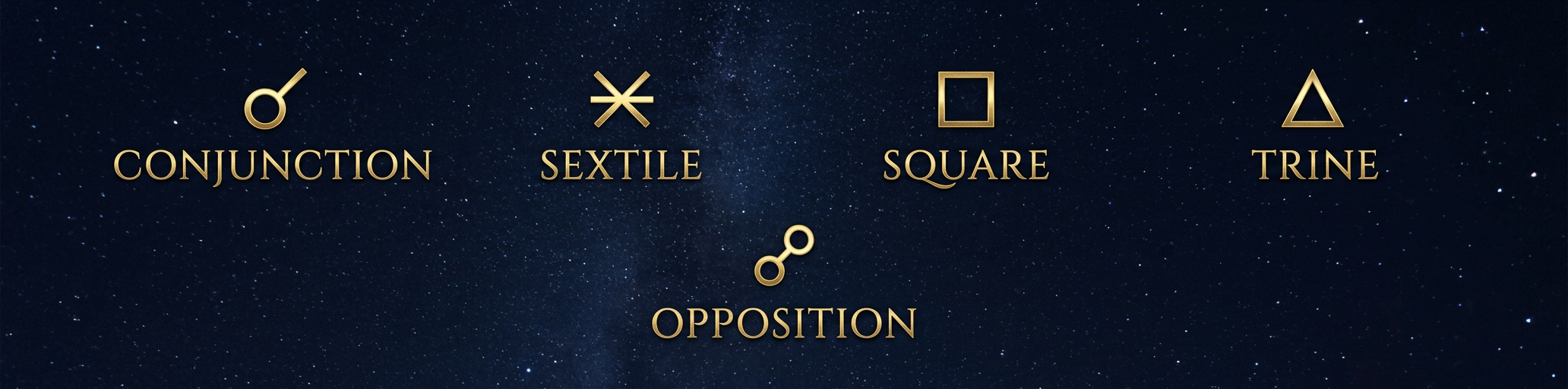
Aspects describe the relationships between planets. These are the angles they form with each other.
Conjunction (0°) – same degree → energies blend
Opposition (180°) – directly across → push/pull, balance
Square (90°) – tension, friction, challenge
Trine (120°) – ease, flow
Sextile (60°) – opportunity, but needs activation
You may hear the word orb—that just means how close the planets are to the exact angle.
What Do You Mean by a “Transit”?
Your natal chart is a snapshot of the sky at the moment you were born. That never changes. But the planets keep moving. When we talk about transits, we’re talking about where the planets are now in the sky—and how they interact with your natal chart.
For example:
If you were born with your Sun in late Gemini, and Venus is currently in late Gemini, then:
👉 Venus is transiting your Sun by conjunction
That means Venus is activating your Sun directly. That activation might show up as:
more visibility
more connection
more creative or social energy
Now layer in your natal chart.
If your Sun is connected to Uranus, that same transit could also trigger:
something unexpected
a sudden opportunity
a surprising interaction
That’s what we mean when we say something is being “triggered.”
Putting It All Together
Let’s walk through how this actually works. Say you have: Sun at 15° Cancer in the 5th house, conjunct Saturn.
Break it down.
Sun – your identity, what lights you up
Cancer – nurturing, protective, focused on others
5th house – joy, creativity, fun
So already we have:
👉 Someone who finds joy in creating experiences that take care of other people.
Now add:
Conjunct Saturn (0°)
→ Saturn brings structure, responsibility, and sometimes restraint
So this isn’t carefree fun. This looks more like:
👉 Someone who expresses their creativity through planning, organizing, and making sure everything runs smoothly
Think:
event planner
the person behind the scenes making sure everyone else has a good time
That’s where this Sun shines.
Now let’s add a transit.
Say:
Jupiter is transiting the 10th house at 15° Pisces, trining that Sun (120°)
Break that down:
Jupiter – expansion, growth, opportunity
Pisces – creativity, intuition, no boundaries, collective energy
10th house – career, visibility, reputation
Trine – ease, flow
Now we get:
👉 Expansion through something creative or emotionally resonant
👉 Something that reaches beyond just you
This could look like:
Someone notices what you’ve been doing
You’re offered a larger opportunity
What you’ve been doing for joy starts becoming something bigger
So now:
What once lit you up personally becomes something that has meaning in your public life.
Note: This is also just one way to read this. Astrology isn’t a single, fixed interpretation—it’s a language, and there are multiple ways to translate it. What you’re seeing here is how it comes through for me when I read it.
Final Thought
This is how astrology works. You’re not reading one piece—you’re layering meaning. You don’t need to know everything to start recognizing patterns. You just need enough of the language to follow along.
That’s what this is for. We’ll get into more complex lingo in a future post.
If this helped you make sense of something you’ve seen before, or if you’ve got a placement you’ve been trying to understand, feel free to drop it in the comments.
